
Your gift powers design for all. As a volunteer-powered 501c(3) nonprofit, we rely on the generous giving of our supporters to bring free and affordable programs to 10,000+ people citywide every year.
- July 29, 2026
- News and Announcements
HOK at SDF 2026: IN[FLUX]
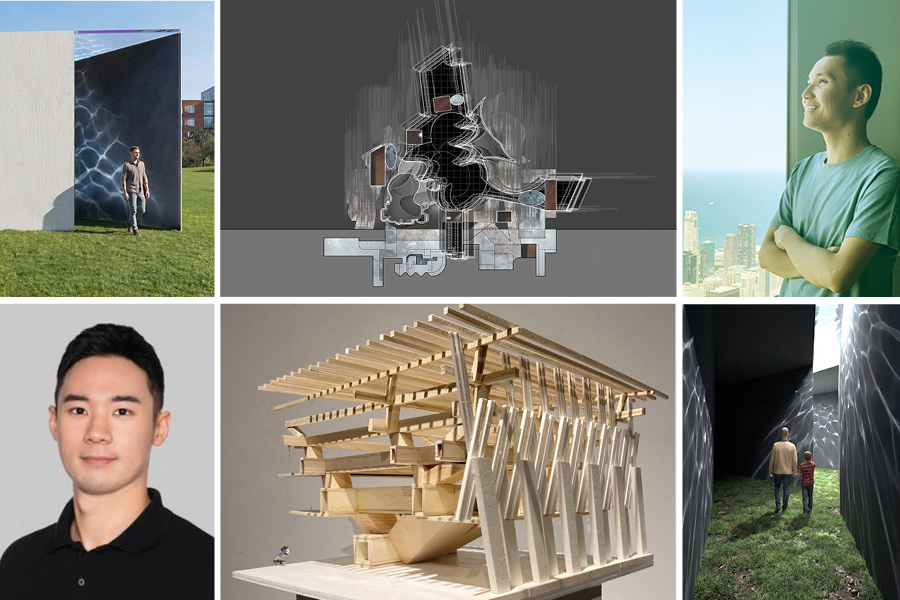
We’re thrilled to have HOK back at the Block Party this year with In[fluid]ence, an exploration of light and movement through the medium of water.
“Through the use of water as a responsive and reflective medium, the installation transforms ordinary environmental movements into a poetic and atmospheric experience. In[fluid]ence encourages viewers to become more aware of the delicate relationships between motion, light, space, sound, and perception, revealing how even the smallest forces can shape the way we experience the world around us.” – HOK Team
Get to know the HOK SDF team
Jacky Wong
Senior Design Professional (he/him)
I’m Jacky, an architectural designer at HOK. The Seattle Design Festival is one of the events I look forward to most each year. It provides a unique opportunity for us to think creatively, explore new possibilities, and apply our practical skills to solve design challenges in a team across the office. Beyond nurturing design thinking, the festival serves as a catalyst for team building and strengthens connections with colleagues as well as with professionals throughout the AEC community. It’s an inspiring experience that encourages creativity, collaboration, and engagement both within our firm and beyond.
Joon Yun
Senior Design Professional (he/him)
I am a Senior Design Professional at HOK. With a strong background in architecture and a master’s degree from the University of Pennsylvania, my expertise focuses on parametric modeling and advanced geometric studies.
Q & A with Jacky & Joon:
IN[FLUX] in design is…
Jacky: IN[FLUX] is movement. It encourages us to observe our environment through a different lens. By re-thinking the opposition between motion and stasis, it makes time visible and reveals the ever-changing nature of our surroundings.
Joon: A reflection of a community’s hopes and dreams for a future where we live in harmony with diverse cultures and perspectives.
How can design respond to IN[FLUX] – constant change and uncertainty?
Joon: Design responds through the potential for movement and transformation. The theme and the beauty of uncertainty lie in how it reflects a community’s dynamics, harmony, and multitudes.
Who or what inspires you?
Jacky: What fascinates me about architectural design is the simple question we continuously ask ourselves: How can we design better? Is it by improving building performance, enhancing user comfort, increasing design flexibility, or something else? Every designer has their own different answers and is driven by their vision of what matters most. It is this diversity of perspectives, combined with our shared commitment, that drives innovation and shapes a better future for all of us.
Joon: I am continually inspired by my colleagues, Erik and Jacky. I truly appreciate their fresh perspectives and their drive to push the boundaries of design.
My favorite thing about where I live is…
Jacky: People. It has always been about the people. My colleagues and the friends I’ve met in Seattle have been incredibly supportive and respectful. Their kindness has given me the space to grow at my own pace. A city is shaped by its architecture, but more importantly, by its culture and its people. Great architecture can make a city appealing, but it is the people who make a city truly special.
What design story or object most strongly influenced your interest in design?
Jacky: One philosophy that reshapes my design thinking is the Japanese aesthetic of Wabi-Sabi. It encourages us to embrace imperfection and incompleteness, reminding us that beauty can be found in everyday objects. Good design is not about pursuing perfection; It is about transforming the ordinary into something extraordinary.
Joon: While no single object sparked my interest, I have always been fascinated by the manipulation of simple geometry using complex rules and parameters. For me, design is driven by a constant internal dialogue of “why” and “how.”
If you could have any superpower, what would it be and why?
Joon: I would definitely negate gravity. It always limits what’s possible, but fighting against it to keep a design standing is honestly the best part of design practice.